


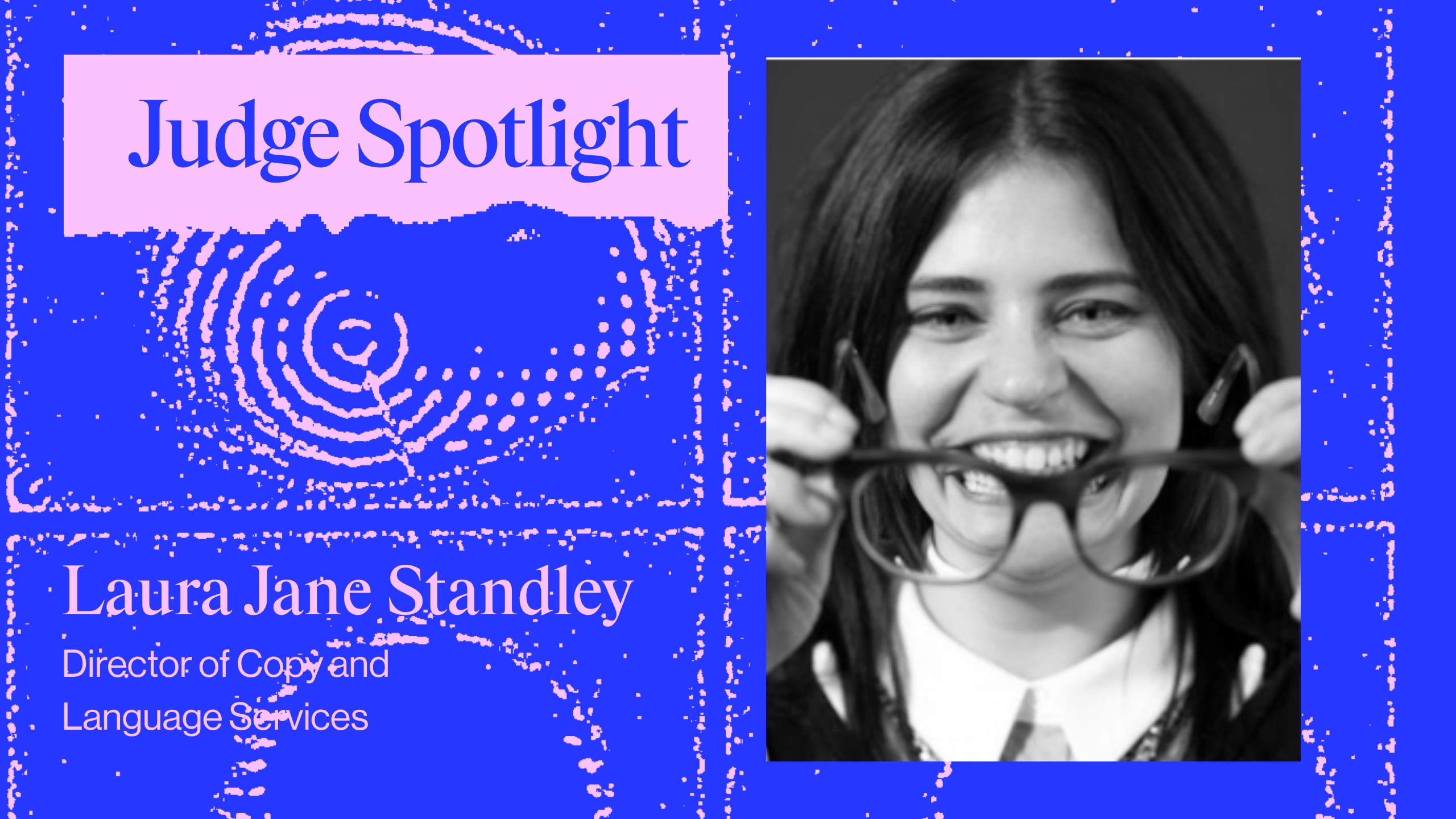
Laura Jane Standley is a writer and editor whose work has appeared in “The Atlantic”—where she wrote the Best Podcast lists for a decade—”The Guardian,” “The Believer,” and “303 Magazine,” among others. She is currently the story editor for “The Adventures of Memento Mori” and the director of copy and language services for the award-winning creative advertising agency Droga5, where she created a program to reduce bias against people, ideologies, and the environment in written communications called Editing for Equality. She has also spoken around the world about how English impacts the environment. She was previously a partner at “The Timbre,” the now-defunct podcast-criticism website.
How many years have you worked in podcasting or audio?
10+ years
What is your current role, in your own words?
In podcasting, a Story Editor.
What types of projects do you typically work on?
Narrative projects that I’m writing about or editing.
How many years have you been a Signal Awards judge?
This is my first year!
What excited you about joining the Signal Awards Judging Academy?
For anything that can help move the craft of podcasting forward, I’m all in. It’s a bit of challenge nostalgia for me, too, to listen to quantity in a way that I don’t anymore. And of course, flattery! Being “peers” with the other judges gives me a nice little ego boost.
What is one recent podcast you’ve loved and would recommend?
Cramped—it’s ostensibly about women’s bodies, but it reveals so much about all bodies and the medical industry in general. Pairs nicely with the book “Eve.”
What separates good audio storytelling from great audio storytelling?
I think when it’s clear that audio is the best medium for the story (like there’s no visual component available to complement the research or the narrative) and when the story has some sort of audio fixture central to it (whether that’s source material from long ago or found audio or the story is literally about music or birdsong, etc.), that makes a podcast as podcast more exciting. It’s gotta have great characters, plot, etc., too, of course. I love when there’s a fresh-sounding audio mix as well.
What project are you most proud of and why?
Writing the 50 Best Podcasts lists for “The Atlantic” for 10 years. Especially in 2015 or so, highlighting new makers helped to launch careers and helped audiences connect with work that was hard to find or parse. I’m proud to have helped shape the industry in some way and to have supported talented people carve out a path, however slight my contribution was. Criticism is a hard writing style, too, and “The Atlantic” taught me a lot about how to be fair and ethical to readers and makers. It was a consistently mind-expanding experience, let alone how listening to thousands of podcasts—with the variety of consciousnesses—a year changed my brain.
What podcasting trend, challenge, or opportunity has your attention these days?
Podcasts as videos and podcasts as pilots for TV—both of these trends are challenges to and opportunities for the medium. Both feel sticky, expansive, and inevitable.
What’s one piece of advice you’d give to emerging creators?
Listen to podcasts. It’s obvious when creators don’t.
What are you currently listening to? (podcasts, music, anything)
Maya Hawke narrates Joan Didion’s “Slouching Toward Bethlehem” very well, which I’m enjoying. As for podcasts, this year I’ve been into “Shell Game,” “The Idiot,” “SUP,” and, of course, “The Adventures of Memento Mori,” among others. As for music, I’m always listening to the Grateful Dead, stuff like Hot Chip and Janet Jackson, local Brooklyn DJs, and a playlist of cheesy music I named “Bathtub,” which is twelve hours long.