


Imagine you had the chance to sit down across from Tim Ferriss. What would you ask him? Or if you had an hour with the likes of Ai Wei Wei, Gloria Steinem or Marina Abramović. How would you open up the conversation?
If you’re Debbie Millman –host of the long-running podcast Design Matters from The TED Audio Collective, a Signal Award Winner and member of our Judging Academy– you surface an esoteric detail from early in their career. The result?
“There’s an immediate understanding, maybe even subconsciously, that I respect them enough to have done this work. I want them to understand right from the very beginning that this isn’t going to be a conversation filled with questions they’ve been asked a million times… All of this research gives me permission to delve,” says Debbie.
As Design Matters celebrates its 20th anniversary this year, Signal’s GM Jemma Rose Brown sat down with the acclaimed host to explore how she evolved her interview practice over the years and created a show with real staying power. Read their interview in full below.
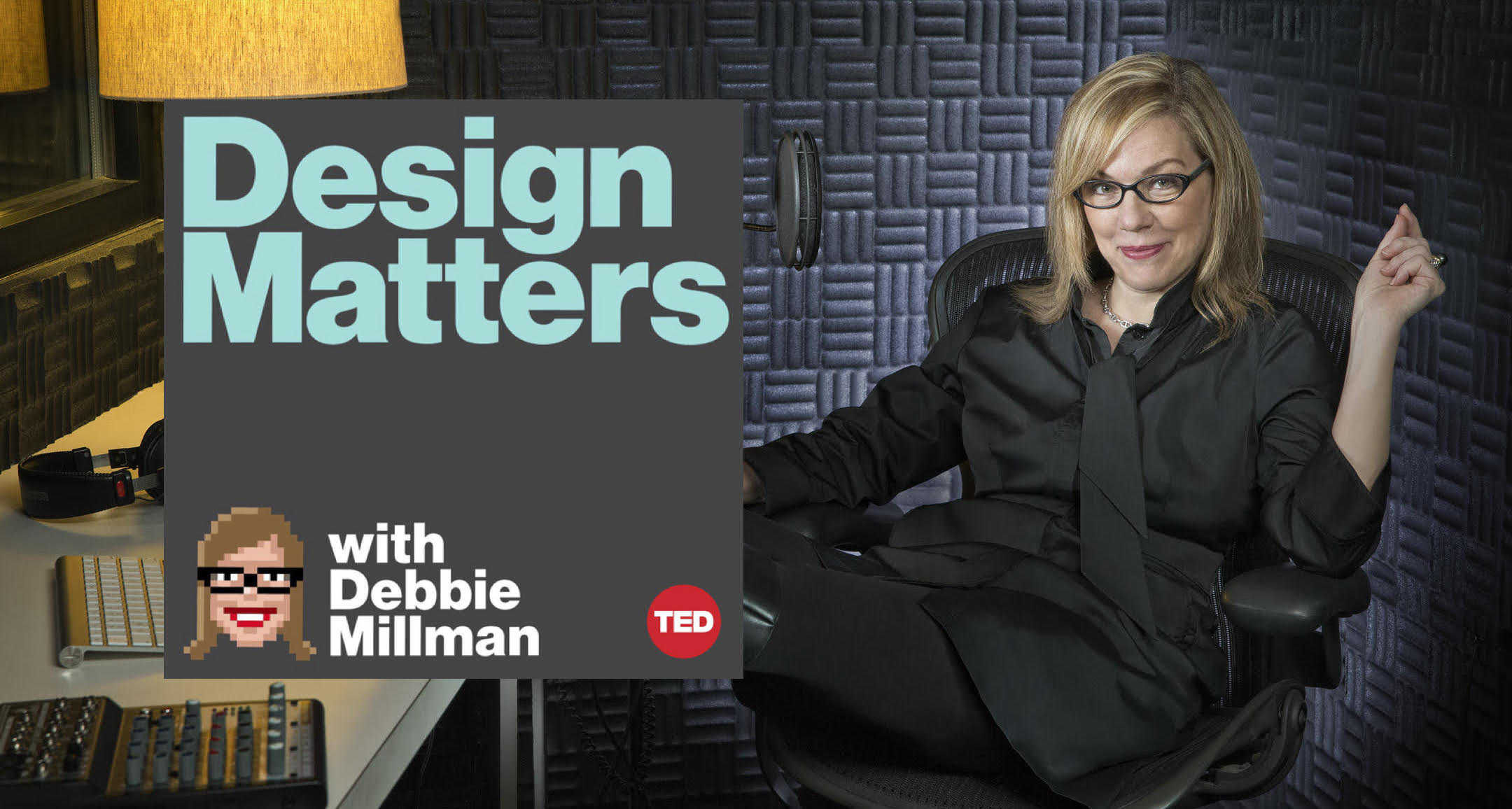
Jemma Brown, General Manager, The Signal Awards: You just hit such an incredible milestone, 20 years of the Design Matters Podcast. Congratulations!
Debbie Millman, Host, Design Matters: Thank you!
Jemma: While thinking about what I was going to ask you today, a first instinct was to return to your very first episode and listen to it.
Debbie: [Makes a face]
Jemma: No no, don’t worry that’s not where this is going. Where it’s going is, so any longtime listener of your show will know you are a voracious researcher, and your trademark move is to dredge up these tiny esoteric details from the early days of your interview subject’s life. But rather than do that to you, I’m actually more curious about where this urge comes from. Why do you begin at the beginning?
Debbie: Well, generally speaking, my first question I consider to be an icebreaker, and I do that for a couple of reasons. One is I want to get my guest to laugh. Laughing immediately relaxes a person. If we both laugh at the same time at their answer, then that’s even better.
The second is, most of the time people are very surprised at my discovery of this little thing about them, and while it might feel like a surprise to them, I also think that there’s an immediate understanding, maybe even subconsciously that I respect them enough to have done this work. I want them to understand right from the very beginning that this isn’t going to be a conversation filled with questions they’ve been asked a million times.
I listen to other podcasts about the guest and I have them transcribed. I develop a narrative arc I want to take with the conversation. All of this research gives me permission to delve
Jemma: It’s such a privilege to speak with you on this occasion because you are one of my favorite interviewers, in large part because you are so vividly locked in with your guests. As one of your listeners, the effect is that it gives us permission to lock in too. There is no passive listening to a Design Matters episode. And so often I can hear pleasure in your voice when you’re interviewing. I’d love for you to tell me about that pleasure. What are you experiencing during your interviews?
Debbie: Nobody has ever asked me that question before! My best friend, Emily Oberman, has said she can always tell when I’m smiling in an interview which also makes me happy to hear. But that isn’t intentional. I feel like I am just responding very organically in the moment. I’m not thinking about my hair. I’m not thinking about my lipstick. I’m just thinking about what the person is saying and picturing it in my mind.
The people I interview are so vivid and multidimensional. I get to learn while they’re talking. To go that deep and learn that thoroughly is such a gift.
Jemma: I love that. Sticking for another moment with the theme of beginnings, but with a twist: I’ve read about the origin story of Design Matters, how you had an office in the Empire State Building back in 2005 and would record the show on a handheld phone. What I’m curious about is, can you identify when the host as we know her today emerge? When did you start to find your stride with the show?
Debbie: So I did a hundred episodes on Voice America from 2005 to 2009. In 2009, I moved the show over to Design Observer at the invitation of another wonderful human who’s no longer with us, the late great William Drenttel, who’s one of the co-founders of Design Observer along with Michael Beirut and Jessica Helfand and Rick Poyner.
And when he did that, there was a caveat that I had to improve the audio. I asked for his input and help and he recommended that I meet Curtis Fox who started as my producer in 2009 and still is to this day.
That’s when I started to take the show more seriously. Like, if I’m gonna do this, if I’m paying a producer, if I’m going to ask all of these people to sit with me in this studio for an hour, I need to take it more seriously. So that’s when I stopped using a template of questions, and when I started to do a lot more research.
I wasn’t listening to NPR at that time. I wasn’t familiar with the discipline at all. Which is probably a good thing because if I had known more I would’ve been way too intimidated to even try. Once I did become aware, then I started to really listen and learn and made a very concerted effort to grow and to challenge myself to get better.
Jemma: It sounds like you’ve made a study of the art of the interview.
Debbie: Believe it or not, one of the first people I really studied was Barbara Walters! Michael Baker gave me her autobiography and reading that was profound. And then I started to really listen to other, primarily female hosts. Krista Tippett was a huge influence. Terry Gross was a huge influence. It helped me in understanding the rigor that they put into doing their shows, and that stayed with me.
Jemma: The ingredients of a Debbie Millman interview: rigor, research and making people laugh,
Debbie: And also giving them the space!
A good interview is like a game of billiards. You are looking at the table, analyzing not just where you want to get one ball in the pocket, but how you can leave the rest on the table to be in a position to go anywhere from there. That’s the way I approach an interview. I want to be so familiar with the body of work that my guest has undertaken and the trajectory of their life that whatever they bring up isn’t going to terrify me.
I want to be able to have a meaningful way of engaging with them no matter what they want to talk about. And yes, I do have a very in-depth script, but I also am aware of where it could go. They are the lead in our dancing. I’m following them. I might have the questions, but wherever they go, I follow them.
Jemma: It sounds like an act of care in a lot of ways.
Debbie: I hope so. I would love to think of it that way.
Jemma: Now I just wanna ask you about your relationship to control, but–
Debbie: I’ll just give you the number of my therapist. You can talk to her directly. No intermediary.
Jemma: Producing a podcast week after week, year after year, it creates a cadence to a life, right? You’re booking, you’re researching, you’re constructing the conceit of the episode. I wonder what value you have found in that act of repetition?
Debbie: I give my grad students an exercise. It comes at the end of the semester and it’s called the 100 Days Project. It was also created by Michael Beirut, and the project is very simple. You commit to doing one action for 100 days straight.
What I tell the students when they start is that the project isn’t only about the project. The project is how you show up through your own experiences of inspiration or resistance or laziness or fear or resilience. That’s what making this podcast has taught me.
Jemma: How has making this show for 20 years been a teacher for you?
Debbie: I’ve really had to learn how to listen.
Jemma: What does that mean?
Debbie: That means not thinking about anything except what someone is saying.
Jemma: How do you do that?
Debbie: You really have to eliminate all of the other distractions that are coming at you. I’m generally speaking in my dark studio and there’s no distraction at all. The only internet is the connection to my guest because if I turn on anything else, it impacts the quality of the feed. There’s something incredibly focused about that experience. I’m not looking at their shoes or the way they’re moving their legs. The phone isn’t diluting the moment. I’m just listening to what they have to say.
Jemma: That kind of attention now is so rare.
Debbie: So rare!
Jemma: Well, Debbie, congratulations on 20 years and thank you so much for this conversation, truly.
Debbie: you for doing this. It means so much to me.